

08/11/2026
According to the San Francisco Standard, "This year alone, there have been 112 wildfires that have each burned more than 300 acres, a 724% increase over the five-year average. Many of those are caused by people. According to Cal Fire, about 15% of wildfires are started by arsonists. But in 2024, about half of the 1 million acres that have burned were the result of arson."
https://sfstandard.com/2024/10/03/cal-fire-firefighter-arson/
"In 2016, the National Volunteer Fire Council (opens in new tab) reported that more than 100 firefighters are arrested on arson charges per year", an averaged of 2 firefighters arrested in every state every year.
"Edward Nordskog has thought a lot about arsonists — and especially about firefighter arsonists. Nordskog spent 35 years as a detective with the Los Angeles Sheriff’s Department, 21 of which were with the arson and bomb unit. He worked on 1,200 arson cases. He’s writing a book, his eighth, about the unsolved murders of firefighters by serial arsonists. During his research, he identified 13 arsonists — four of whom were firefighters — who were never brought to justice." Said differently, about a third or 33% of Los Angeles Area arsonists were firefighters.
"Nordskog said fire service employees generally set fires for selfish reasons: either recognition or money earned from overtime work putting out the fires they start"
“It’s usually bullshit, but they say, ‘I’m doing it so my guys can get some training,’” said Nordskog, who has studied at least 200 firefighter arson cases and worked on a dozen himself. “These guys who do this don’t want to be viewed as somebody sick or twisted — that’s how people perceive serial arsonists"
"Nordskog says there’s another reason firefighters start fires, a mundane reason: boredom. Fire service work, particularly for small departments, doesn’t match the stories of adventure promised in the academy, where, he said, recruits are told, “You’re gonna be slaying the dragon every day, [and] the guy who’s talking is this old chief with a big mustache, he’s got a burnt up fire helmet on his head. The average U.S. firefighter combats only a handful of structure fires a year."
“Then all the problems that follow bored firefighters come to light — fighting in the firehouse, wife swapping, gambling, stealing, extreme hazing, issues nobody will tell you about — and then, eventually, someone starts lighting fires,” Nordskog said. “Usually, the local fire guys know almost right away that it’s one of theirs.”"
"Alan Carlson, a retired Cal Fire investigator who nabbed a volunteer firefighter in a hallmark case called Operation High Desert, said almost a third of wildland arsonists arrested are connected to emergency services."
This corroborated the Sheriff's statistic that about 33% are connected to emergency services.
"“It may be that teenage boy whose father is with law enforcement, or it could be somebody that’s an explorer scout learning to become a police officer and those types of things. Or it could just be, which is most frequent, a volunteer firefighter,” he said."
"Hernandez knows it’s a black eye for Cal Fire and inmate firefighter programs. After his arrest (Robert Hernandez is who set five fires around the home of the mother and then the brother of a cluster of Northern CA Epstein victims in 2024)"
Applying the twice-repeated 1/3rd statistic to the 12,000 firefighters in CA, and that's equivalent to 4,000 firefighters in California setting California on fire, because they are in "need of being perceived as heroes", by burning down communities, and then saving a few houses and business, and being fed non-stop "you our heroes", but little do the citizens of CA know, it's their heroes burning down their communities, because they need to feel praised.
It's like a crack addiction and affects the same part of the brain that is broken, the ventromedial nucleus crave center of the hypothalamus, constantly asking themselves if they have enough Maslowian status and friendship resources -- and they rarely do -- and so like junkies, they burn down our communities and forests because they have mommy and daddy issues, and they need you to praise them like drug dealers push relief to addicts.
This mental health crisis in California is known as Hero Syndrome.
"Firefighter arson is a persistent phenomenon involving a very small minority of firefighters who are also active arsonists.[1] Fire-fighting organizations are aware of this problem.
Firefighter arson is also one of the major reasons the term "hero syndrome" was coined and brought into popular discussion. Firefighters committing arson is commonly believed to be a form not only of hero syndrome but sometimes of other disorders and/or disabilities pertaining to the mind. These include but are not limited to borderline personality disorder, depression, alcoholism, pyromania, and suicidal tendencies.
The FBI study found that the arson cases involving more than one firefighter frequently were associated with department programs designed for younger participants, such as those for apprentice firefighters, youth groups, or auxiliary firefighter programs for teenagers.
Whereas "Hero syndrome (also often referred to as hero complex) is a psychological phenomenon which causes a person to seek recognition for heroism.
Although hero syndrome is not recognised by the American Academy of Psychiatry due to its inconsistency with the definition of a syndrome,[1] it is, by definition, a complex, as people who present this often exhibit impulses that have a "common emotional tone and exert a strong but usually unconscious influence on the individual's attitudes and behavior".[2] However, in popular media and literature, it is referred to as "hero syndrome". The term is used to describe individuals who constantly seek praise for valiant or philanthropic acts, especially by creating a harmful situation which they then can resolve.[3][4]
This can include unlawful acts such as arson. The term has been used to describe the behaviour of public servants, such as firefighters, nurses, police officers, security guards and politicians.[5]
The behaviour of individuals with hero syndrome can be detrimental to the lives of those around them, putting innocent people at risk in the pursuit of creating a "victim". Reasons for this kind of behaviour often vary.
The term "hero syndrome" was first introduced following the discovery of a bomb on the 1984 Turkish Olympic team's bus by Los Angeles police officer Jimmy Wade Pearson. He presented as the only police officer available on the scene after he "discovered" it. Pearson ripped the device's wires out before running it out onto a runway. He was hailed as a hero by the public until he was arrested the following day for planting the bomb himself.[6] This raised questions as to people's desire to commit crimes to create scenarios for themselves to be the heroes.
Aetiologies and contributing factors
Narcissism
The causes of hero syndrome are predominantly rooted in narcissistic tendencies. Narcissism usually presents itself in one of two ways: vulnerability-sensitivity and grandiose-exhibitionism. The latter is what is most often found to coincide with hero syndrome.
Individuals with this form are often described as egotistical and show-offs and are aligned with high levels of manipulativeness and self-dramatisation. There is a deep desire to exhibit attention-seeking behaviour and impress others. A similar relevant concept is also referred to as overt narcissism in which people are constantly obsessed with the perception of themselves by others.[7]
Due to high, fragile self-esteem and a failure to see fault in their own actions, narcissists are more susceptible to portraying others as the victims or villains in order to boost their image.
Cultural differences
The categorisation and characterisation of heroes differ between cultures, and as a result, create disparities in how hero syndrome may present itself in different circumstances.
The classification of heroes in individualistic cultures revolves largely around the idea of "rescuing" someone from harm by putting themselves in physically dangerous situations. "Heroes" in these cultures are considered brave, reliable, strong, etc. Furthermore, features that were critical to defining someone as a hero included: self-sacrifice, altruism and selflessness.[8]
In contrast, collectivistic cultures typically categorise heroes as those whose actions serve the collective goal. Heroes in collectivist cultures need to place the needs and interests of the group above their own. A sense of patriotism and nationalism in some cases may also be relevant in the construction of a "hero" in collectivist cultures.[8]
These differences between cultural "hero" stereotypes may also translate to how hero syndrome may be portrayed. Violent crimes and physically dangerous situations may be therefore more prevalent in individualist societies due to the element of bravery and sacrifice involved.
Examples and case studies
Firefighter arson
Firefighter arsonists include the very small proportion of firefighters who are dispatched to put out fires of which they were the cause; that is, fires intentionally set by firefighters so they can also gain the satisfaction and accolades of being the heroes and saviours of the incidents.[9] In a federal study of more than 80 firefighter arsonists in the United States, the most common reason cited for starting the fire was simply the excitement of putting it out, not to cause harm or exact revenge.[10] Though not all, many recall their motives for committing arson as wishing to be perceived as heroes to other firefighters and their community, committing what may be referred to as vanity fire setting.
Arkansas: Perry County Deputy Sheriff
In 2004, an Arkansas police officer reported as being in foot pursuit of a man whom he had recently called in to be on the lookout for. Not long after, the police officer announced he had been shot in the abdomen and gave a very detailed and comprehensive recount of the events that had transpired. An extensive investigation and search were then carried out, collecting evidence and conducting interviews, resulting in the officer eventually pleading guilty to fabricating the entire story and shooting himself. This crime was also committed with the intention of being a victim, simultaneously portraying himself as a hero injured in battle.[4] Hero syndrome is often also found in conjunction with victim complex due to their similar ideals.[11]
Real-world applications
There is already-existing controversy about workplace and employment mental health screening due to the ethical concerns raised regarding biases, false negatives, etc. However, in certain fields where people display harmful and risky behaviour in an attempt to be perceived as saviours, ethics are also very relevant regarding the safety and harm of others.
Emergency services and healthcare workers
For first responders and those working in the medical field, hero syndrome is particularly relevant. These are careers often labelled as 'heroic' and have the potential to attract those with hero syndrome due to the constant ability to exhibit courageous and heroic acts. In such careers where agent-patient dynamics are prevalent, people assume the roles of saviour and victim, and heroes can emerge.[12]
Having individuals who suffer from hero syndrome in this field would increase the prevalence of self-inflicted incidents, creating a drain on resources of both time and people.
In some cases, however, these careers fuel the hero syndrome, as individuals want to "show off" newly learnt skills, impressing those around them.[9]
To combat this, many emergency services, such as fire departments, are incorporating the teaching of the severity of crimes into programs. For example, the fire departments rolled out additional teaching on arson crimes to reinforce the firefighters' duty to support and serve their community and to not bring shame and stigma to the fire department.[9]"
https://en.wikipedia.org/wiki/Hero_syndrome
Interestingly, using statistics, we discovered the following "invisible arson", where the arsonists were setting so many fires up North and Down South and on the West Coast as to drown out local statistics, where years ago we observed that Cal-Fire pilots were engaged in a pattern of stalking Epstein victims, then engaged in ongoing Epstein victim intimidation, whistleblower retaliation, and RICO obstruction of justice. So we checked with Claude AI, who specified that yes indeed this cluster of fires off US-50 going East from El Dorado county is characteristic of arson, because the fires are too close together, and all off the highway, versus deep in the woods, caused by lightning, ruled out. So we performed regression analysis on the confirmed arson events.
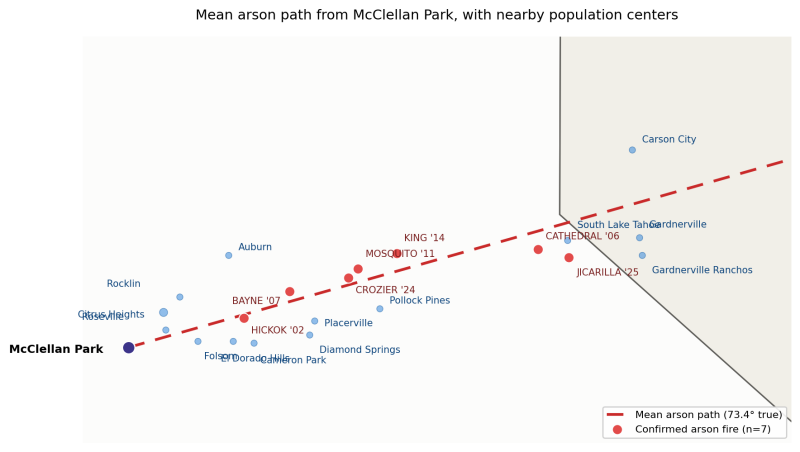
And so about 4,000 firefighters set CA on fire every year in order for communities to praise them is disgusting.
Additional research revealed many of them have all sorts of mental problems, and are angry, and violent, and generally have a poor ability to control themselves, classified as dark triad personality types.
Unfortunately for Cal-Fire, we can prove massive crimes against us by them, due to them joining the conspiracy to stalk and terrorize us, and now it is a reasonable inference that we can prove Cal-Fire arson fires about our family's homes, which we statistically identified with Claude AI and separately linked to Jeffrey Epstein, and which has as its intent the stalking and intimidation of our Editor to RICO obstruct victims, using dive-bombing and accelerating government aircraft, nearly flown into his home, and almost daily, and through out the day -- and now we know why -- because firemen and US law enforcement, are more likely than not, constantly setting CA on fire, seeking constant praise.
A type of disaster capitalism, where they create the problem, then they assign themselves to the solution, usually making money on both ends.
And they have been using the same to stalk and threaten our Editor with death almost every day and often all day.
Accordingly, look no further than police and fire when your community has been set on fire.